|
1Likes
-
The leak/seepage repair seems to have worked. All that I have noticed is an occassional extremely small bead of what I think is excess Loctite working it's way out.
Today the apron and carriage came off.
The apron rigged for removal. There are 8 screws attaching the apron to the carriage, 4 have totally removed, and the other 4 have been loosen. I put some tension on the strap, and then removed the other 4 screws, then the apron was lowered enough to get clearance for the cross feed gear to clear the carriage, and the forklift was backed out, and moved to the front part of the shop, where the apron was transferred to a skid.


If you've ever wondered why a Monarch's apron has to removed before the carriage can be removed, here's the reason. The gib on the left can only be accessed by removing the apron.

This attempt at removing the carriage had to be rethought. There was no way something bad wasn't going to happen.

Not perfect, but at least the carriage wasn't out of control. You can barely see the second strap, actually it's one of my truck binder straps. The front strap was relocated to the intersection of the bridge and the wings, that's the reason for the 2X's.

Harry
-
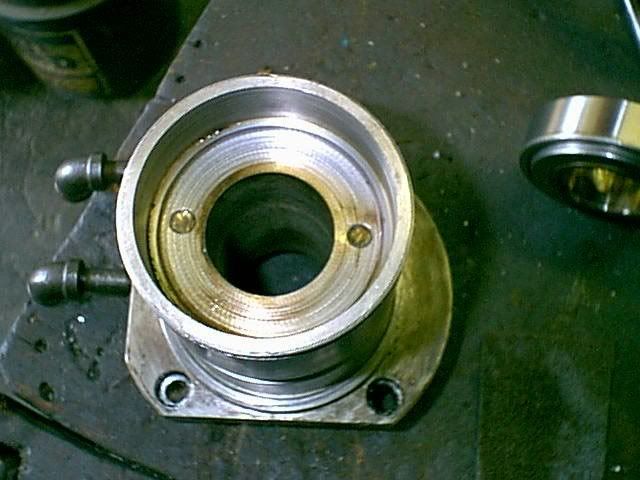
There is a bearing cartridge for the leadscrew that goes into the gearbox and is retained by a cap. There was so much paint and dirt is this area when I took it apart that I never saw the gap between the cap and the gearbox, but I saw it today. Checked the manual and there is supposed to be "Linear O ring" between the gearbox and the cap. The question of the day is this a special type of O ring, or just a 50 year old name for an O ring? The gap is about .050", and the ID of the O ring would be about 3-7/16".


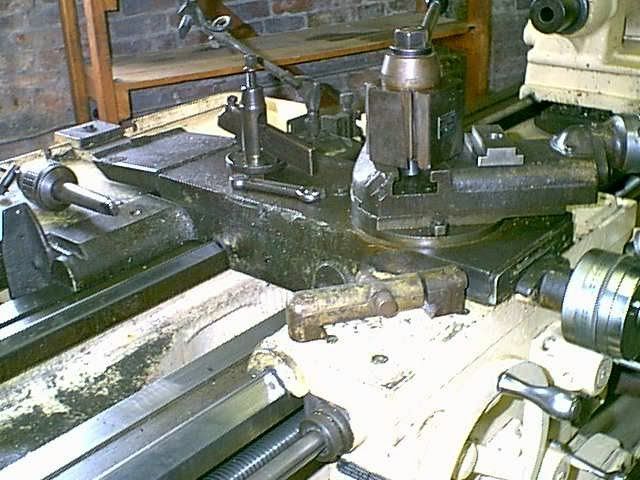
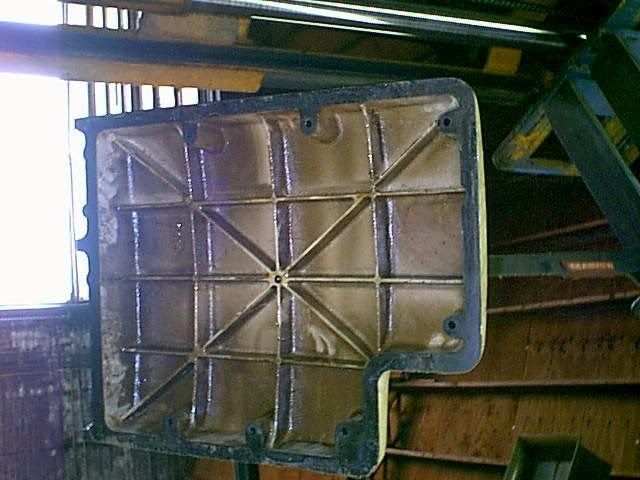
Overall view of the bottom of the carriage. There are 8 meter units that I've found, so far.3 are in the apron section and 5 are in the bridge section. The bridge was almost a solid mass of grundge. I excavated most of the junk out, being about as delicate as a dentist excavating an impacted tooth. There still a lot more cleaning to do.

I'm not to encouraged by what I've found so far, I do believe there is more to do than I hoped for; maybe a little Multifil 426. I'll be running some checks over the next day or so.
Harry
-
Linear O-ring
Linear is indeed a brand: Linear Incorporated State Rd. & Levick (sp) Philadelphia Penna
They put out dimensional data for installation of std sizes of Linear O-ring packings in 1944. Don't know if they are still around. Drawing no 1821.
With a .050 gap you probably want an .070 cross section O-ring. I dont see the exact installation gland in the pics.
Size 043, 3 1/2 Nom ID, actual ID 3.489
Size 042, 3 1/4 Nom ID, actual ID 3.239
O-rings are generally sized to stretch if installed in an OD gland,
and conversely to compress slightly if installed in an ID gland,
this aids during assembly to prevent damage as the O-ring is compressed as the parts mate during assembly.
This application appears to be a face type seal from your information so you select a size that will stay in place while you assemble the parts.
Stan
-
O-ring elastomer
You will want oil resistance and whatever else it sees, probably 70 Durometer, Nitrile. Viton should work also. Just tell the guy or gal at the seal supply house what the fluids are and they should be able to fix you up.
Stan
-
Stan,
Thanks for the information. This shouldn't be hard to find.
Harry
-
Rechecked the leveling I did shortly after moving the lathe in. I was pleasantly surprised to find that nothing had changed, either longitudinally or transversely. The leveling was done using the flat ways. The recheck was done in preparation for a more thourough assessment of the carriage. In an attempt to determine the amount of wear on the inside face of the front V way, I set up the loaner King Way Alignment Tool (KWAT), using the inside ways as the datum plain. Either I'm using the KWAT wrong, or this tool is highly overrated. I could not get any repeatability checking levelness, when double checking the reading. I did not have any problems using the Master Precision Level, although it did take a bit longer. I finally set up an indicator on the TS using a mag base and cranking the TS back and forth. One has to be careful about cranking, there are some pitfalls. I finally disconnected the crank and just pushed the TS about 7', which wasn't easy on a dry bed. The results are approx .007" wear on the inside front face, and about .003" on the outside face. It's a little more than I expected, and hopefully this won't be too much of a problem.
This was prompted by the condition of the carriage. I think most of the oil lines are clogged, and there is, visibly, what appears to be a lot of wear on the V slide. I do believe there is going to be a problem with the oil pump.
I did get the carriage a lot cleaner today, and there are 8 meter units, all 00 size. If I have to replace the 3/32 brass tubing for the lube lines, I've got quite a bit on hand. I bought about 100' 20 years ago when I was working on a B&S mill, and stashed it away and forgot about it, until I saw those tiny lines. All I need are the compression sleeves.
Anyway a couple of pictures. The first one is the KWAT and the MPL. And for the member who was giving me a hard time about the brightness of the blue, it's the flourescent lighting. I darkened it up a bit, but not quite enough, to get the color a bit closer to the way I see it.

Bridge area of the carriage is a lot cleaner. Notice the oil hole in the inside flat slide. If I understand Monarch's design the inside flat slide is not supposed to bear on the way. Maybe they were anticipating the carriage wear.

Harry
-
I am attempting to determine the amount of wear in the carriage, and not meeting with much success, so far. The carriage was put back on the bed and moved towards the TS end, where the least worn portion of the bed is. The leadscrew was also re-installed along with the carrier bracket, to support the screw, and get most of the sag out. I then used a height gauge to measure from the bottom of the carriage to the bottom of the screw, and repeated the process on the headstock end. So far, I'm good. Next the screw was placed in the apron and the half nuts closed, locking the screw in position. Measurement was taken from the top of the apron to the top of the screw, and knowing Monarch, this should be a nice round number, in 1/16th's, 1/8th's, etc. and it was. Now the troubles began. After subtracting the screw diameter from the first measurement, the dimension should have been less than the second dimension. It wasn't, it was more, by about .012", definitely not what I was expecting. These measurements were repeated a couple times, in case I goofed, I hadn't. Next I placed a V block on the unworn sections of the bed by the headstock and the tailstock, and measured the screw distances again. What an eye opener, there was approx a .012" difference. Keep in mind that the gearbox and the end bracket are keyed to the bed. I next took the same measurements on my CY, a lathe I've had for 20 years, you guessed it the same discrepancy, only the ends are reversed. For a sanity check, I called another forum member and explained the problem. He suggested that I check using the feed rod as the reference, which I'll do tomorrow.
Anyway some more pictures, the first and last ones have already been described.

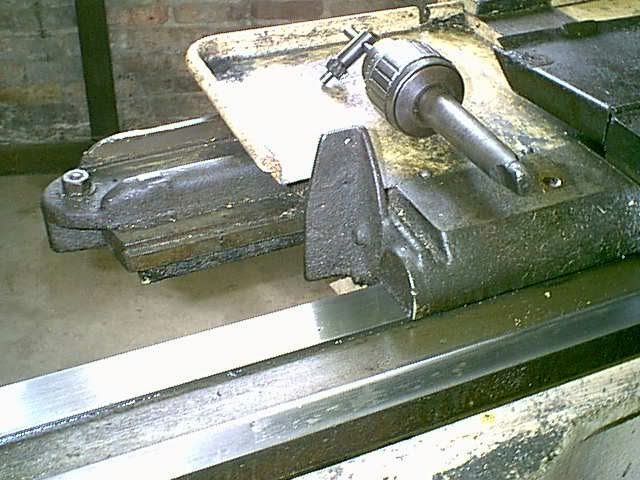
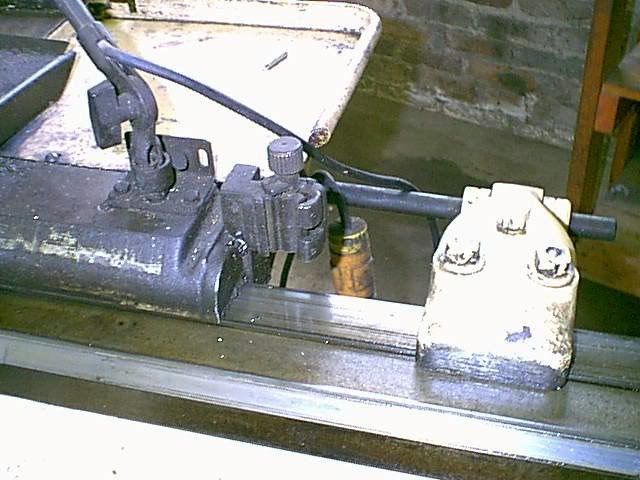
Notice the amount of clearance between theinside bed way and the carriage, approx .003"
on the TS end, which decreases at the headstock end. The inside flat way exhibited the same type of clearances. The white denote the strap position for balance, I also stabilized the carriage front to back to keep things "safe". The carriage weighs 212 LBS.


Harry
-
Harry, do you have access to an autocollimator?
For a long bed like this my inclination would be to set up an autocollimator on the spindle axis, then use the tailstock base as a platform to measure the bed alignment and twist.
-Dave
-
Dave,
No access to an autocollinator. The bed was checked in several spots, in both directions. It is as level as I can reasonably get it. The only thing I haven't done, and probably won't, is spot the bed.
Harry
-
Just to make sure I got it right, I had to put my own dimensions into your problem. So for simplicity the carriage to bottom screw measurement = 5", the leadscrew = 2" diameter, which equals 3" of theoretical space from apron to top of leadscrew.
While you say that the apron to top of leadscrew = 3.012?
If I have got that right then why should it be less than 3"?
Wouldn't the wear in the leadscrew and the halfnuts account for this?
Sorry for the dumb questions but I would like to understand this and maybe do the measurements on my lathe.
Nice job on the paint as well.
Regards,
Michael
-
The wear on the lead screw should be all on the faces and very little on the OD.
My EE's saddle was very worn. Worn so much that the flanks of the v way were not even touching the bed. The head end of the saddle was riding on the rounded top of the v way. Guess thats why there was almost no wear on the ways since it had been rebuilt. If I remember the head end of the saddle was sitting about .025 lower than the back.
-
The location of the leadscrew is a constant. On this lathe, the leadscrew is 1-1/2" D, the measurement from the top of the apron to the top of the screw is 2-1/2", from the bottom of the carriage to the bottom of the screw should measure 4". Yesterday it measured 4.012", and should have been 4", or less. The additional .012" means I was making an error somewhere in my procedure, or else the cast iron is growing somewhere, which is highly unlikely. I was expecting less due to wear in the bed and/or carriage. When I found what I wasn't expecting, I was very perplexed.
What I didn't factor in yesterday was sag in the leadscrew over a short distance. I learned a good lesson.
Today's adventure;
Yesterday I hadn't cleaned the screw, today it got cleaned. I got tired of handling that filthy screw. While I had it in my CY, I took the opportunity to do a run out check on the OD of the threads with an indicator, which was prompted by the fact that my hand was going all over the place while I was running a paper towel over the threads to get the majority of the WD 40 off. That screw is definitely not straight, in the last 46" of length the travel indicator showed a .030-.040" movement.
I mounted the screw in the lathe, and marked the screw in 2 places 180* apart. I next used a V block and established a dimension at the headstock and tailstock ends for the screw, top of V block to bottom of screw. I also took 2 measurements 180* apart, mostly to check for consistency. I next took the same dimensions next to the carriage, on each side, to establish the amount of sag in the screw. I next took dimensions from the the bottom of the carriage to the bottom of the screw, and factored in the sag. After doing the arithmetic, I arrived at the 2-1/2" dimension. At least there was no growing iron, but I could not come up with any wear either, which is very strange. This machine is 55 years old, it's got to have wear. I can see and feel it in the carriage slides, I can see it in the level readings, but I can't actually measure it. I tried twisting the carriage on the bed, 0 movement, the indicator didn't even give a hint of moving. I'm missing something very simple, what, I don't know. These checks were run at both ends, I simply can't find any carriage drop checking the screw, and it should show up. I can find it checking the inside flat way off the carriage.
Take a close look at the bottom side carriage picture. The paint is worn off the carriage where the inside V way passes underneath, probably from chips getting caught, but it extremely close to contacting the way.
After all this, I have decided that going after this "phantom" wear has got to stop, and I can get my sanity back. I not going to do any major work on the slides, fortunately.
Harry
-
Oh yes, now I see the problem. The stanley 25' tape measure you are using just isn't accurate enough! 
Good luck with the phantoms.
Michael
-
Have you checked using the bottom underside of the front and rear ways as references? Don't know about your model but on many precision lathes (for sure on a 10EE) those surfaces were produced to the same alignment and precision standards as the original top way surfaces. It's rare to find them worn or messed up, they are a golden source of datum. Take a look, if they're ground, they're the standard on an old machine, a true unworn artifact of origin.
Hope this isn't a "rebuilt" lathe, seen both scraped and ground where the relationship between the upper and lower bed surfaces was ignored. Not good.
-
The whole purpose of the above exercise was to establish the relationship of the carriage to the leadscrew and the feed rod. I was looking for excessive wear in the carriage slides, which I haven't found. If need be, I was prepared to set the carriage up on my #4 Cincinnati and take a cut on the slides, then epoxy Garlock Multifil 426 to the slides followed by scraping. I would need to determine how deep to cut and to allow enough scraping stock on the Multifil so that the 2-1/2" dimension would be restored. As it stands now, and unless I find something to change my mind in the next few days, I don't have to do the above, fortunately.
There simply is not enough definitive information that I can rely upon.
There have been no prior rebuilds on this lathe, a few repairs yes. I can definitely tell that this lathe has had a few problems that were attended to.
Harry
-
If I understand correctly you were trying to to make measurements to the lead screw to determine how much the carriage has dropped from its original height due to wear on the carriage way surfaces. And also wondering if you're missing something.
"The location of the leadscrew is a constant."
True but the lead screw is not positioned with enough precision at manufacture to use it for a datum for your purpose. Its gearbox end location is established through a considerable tolerance stackup of machined interfaces, for instance: bed attachment surfaces, gearbox location surfaces, bore location in end plate and gearbox. Same kind of deal for the tail bearing location although it was simply bolted to some probably gaged vertical postion and pinned. It's simply not necessary to align it to precise small limits because they're quite flexible and as any operator of an old and worn machine can attest to, they still work.
Consider the bracket on your carriage to support the feed rod and lead screw, they're quite whippy.
Your measurements have verified the current carriage altitude will play nicely with the leadscrew alignment so no problem there.
No idea what the original carriage height was from those measurements however. I suspect Monarch did the logical thing and planned on the carriage dropping as the lathe wore and fitted the leadscrew versus half nut heights accordingly. Fit it so the half nuts start a bit high and drop through a long life sweet zone. Similar to the practice of fitting a tailstock axis high at manufacture. The side shot of the carriage on the ways gives me the impression the carriage has dropped a fair amount, the tailstock vee way looks almost in contact with the carriage.
"I don't have to do the above, fortunately."
I'd come to the same conclusion and put it back to work. It's still in the sweet zone and will do nice work.
-
Dave,
I'm not quite sure of the meaning of your last post. While I will agree with a few of the statements, I disagree with the rest, mainly the section on manufacturing tolerances. It has been my experience, in rebuilding 2 Monarchs, with a 3rd in progress, and this current rehab job, that Monarch paid attention to the tolerances and alignments of the various components that went into their machines.
Today I put my #4 Cincinnati to work, along with the first use of the vertical head that I've been tripping over for a number of years. I increased the clearances in the V slide groove and inside flat slide by approx .015- .020", and the bed's inside V way clearance by about .040". The milling took 2 set up, the first to get the V slide and flat way and the second rotating the carriage 180* to get the bed's V way clearance.
The V slide completed and the flat slide in process.

The milling completed.

Harry
-
Harry,
did you see Forrest's post in the General New forum regarding wire sag tables? If not here is a link.
Wire sag table (for the retro aligners)
You can check the bed for wear and leadscrew alignment directly using those tables, you just need a spool of .016" wire and a 30 pound weight.
It would make a great article for HSM...
-Dave
-
Dave,
I saw Forrest's post on the wire sag tables. I saw one of those set ups in a book years ago, and I'm not inclined to go in that direction at this time.
I submitted an article to HSM 3 or 4 years ago. From the response I've had to the project from those that have seen it, and a few that followed through by contacting me, I think it has some real possibilities. I've yet to see the article published, and it's a lot effort that goes into an article.
After milling the clearances in the carriage, I performed the same indicator checks as before, and for the most part nothing changed except the reading from the carriage to the inside flat way. The amount of drop decreased .002-.003", for a net change of .005",an improvement. It also tells me that the inside V way was most likely making contact with the carriage as it neared the headstock.
I have replaced 3 of the steel oil lines with copper lines. These were located under the bridge, and lubricated the rear flat way, 2 lines, and 1 for the cross slide. This carriage has oil lines for the right and left sides for each of the outer ways.
The apron has been disassembled, cleaned up, painted and is in the process of being put back together. I keep forgeting how challenging these are, especially the clutches. There are some strong springs in the feed clutches, and not much room to work with.
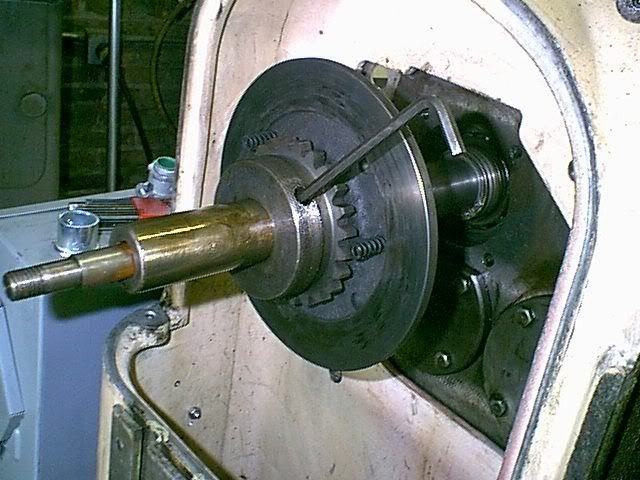
One of the 2 chrome plated retaining screws, below, was found when I removed the rack pinion shaft's cover. A nice touch, but I need that screw for the tailstock handwheel, so I substituted a thick washer and a socket head screw. The manual shows a screw with the spanner holes, but I don't think it was chrome plated.

The handwheel pinion shaft has to be installed first. The traversing clutch has to be assembled in the apron, but the large rack pinion gear has to first be in the apron, loose.

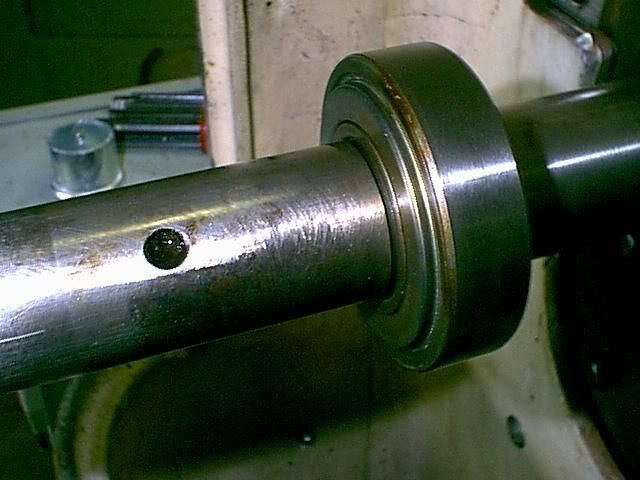
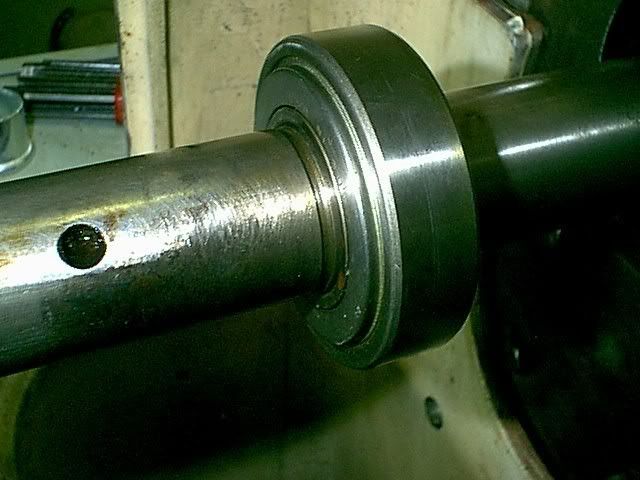
The apron's worm with thrust bearings, on right, the drive plate, center, and the driver, left. The respective bushing are behind, with the right side bushing still in the apron.
The driver and the bushing need to be reworked to account for a lot of wear. I'll turn the driver, bore and sleeve the bushing, and then rebore to fit the driver. There is some wear on the drive dogs, that still I'm deciding what the best way to approach them is.
Overall, the apron is in very good condition. There appears to be minimal wear on the worm, worm gear and half nuts. There are a couple of bearings, ordered, that need replacing on the worm gear shaft.
For the curious the worm is a triple start.

Business end of the driver.

Another view of the drive plate and worm.

Harry
-
Dave I am currently rebuilding(slowly) a model 61. I found a simple method to deal with the clutch reassembly. What I did was to use a 20" Bessey L clamp, short piece of aluminum 1" with a 3/4" id 1" od and compressed the sleeve into it's bore until you can see the tapered pin holes you can align them with a tapered punch. I marked the shaft and sleeve so I could get the taper holes close before the installation, made a tuff job very easy.
G'day zeo
Posting Permissions
- You may not post new threads
- You may not post replies
- You may not post attachments
- You may not edit your posts
-
Forum Rules
|
Bookmarks